Agentic Design Automation for Embedded Systems: The Promise, the Peril, and the Proofs
Agentic design automation is transitioning rapidly from demonstration to deployment in embedded systems, marking a paradigm shift driven by radical gains in cost, turnaround time, and optimization quality. I will begin by presenting a vision for multi-agent EDA flows spanning architecture through signoff—combining physics-based AI, dynamic training, and adaptive algorithms. These flows constitute novel ecosystems of distributed, semi-autonomous participants. Left to develop organically, they lack robust identity verification, scoped credentials, and auditable execution traces. This creates deep architectural exposures: poisoning attacks and backdoors that carry contamination directly to silicon; tool metadata and inter-agent messaging that laterally propagate malicious injections; generator and verifier agents—derived from common models—that unwittingly certify their own errors; and agents that optimize for checkable proxies rather than true design intent. Compounding these risks, shared contexts dissolve confidentiality, and continual adaptation leaves no fixed artifacts to formally certify. The resulting defects are fabricated, replicated, and unpatchable.
I will then examine methods for thwarting these threats through AI resilience anchored in physics-based ground truth, hardware/software co-design for attestation and provenance, and cryptographically secure computing. Ultimately, these defenses converge on a single foundational question: How do we establish verifiable trust in the agents that monitor other agents? I conclude with the technical challenges and opportunities ahead.
Bio:
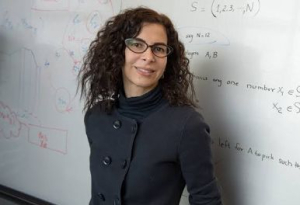
Farinaz Koushanfar is the Siavouche Nemati-Nasser Endowed Chair Professor of Electrical and Computer Engineering (ECE) at the University of California San Diego (UCSD), where she is the founding co-director of the UCSD Center for Machine Intelligence, Computing & Security (MICS). She is also a research scientist at Chainlink Labs. Her research addresses several aspects of AI-based design automation, with a focus on AI/LLM-driven optimization, AI validation and security, robust machine learning/LLM under resource constraints, hardware and system security, intellectual property (IP) protection, as well as privacy-preserving computing. Dr. Koushanfar has received a number of awards and honors including the Presidential Early Career Award for Scientists and Engineers (PECASE) from President Obama, the ACM SIGDA Outstanding New Faculty Award, Cisco IoT Security Grand Challenge Award, MIT Technology Review TR-35 (World’s 35 top young innovators), Qualcomm Innovation Awards, Intel Collaborative Awards, Samsung SAIT University Leadership Award, Young Faculty/CAREER Awards from NSF, DARPA, ONR and ARO, as well as several best paper awards. Dr. Koushanfar holds a PhD in EECS and an MA in ML/Statistics from UC Berkeley. She is an elected fellow of AAAS, ACM, IEEE, National Academy of Inventors (NAI), and the Kavli Frontiers of the National Academy of Sciences (NAS).